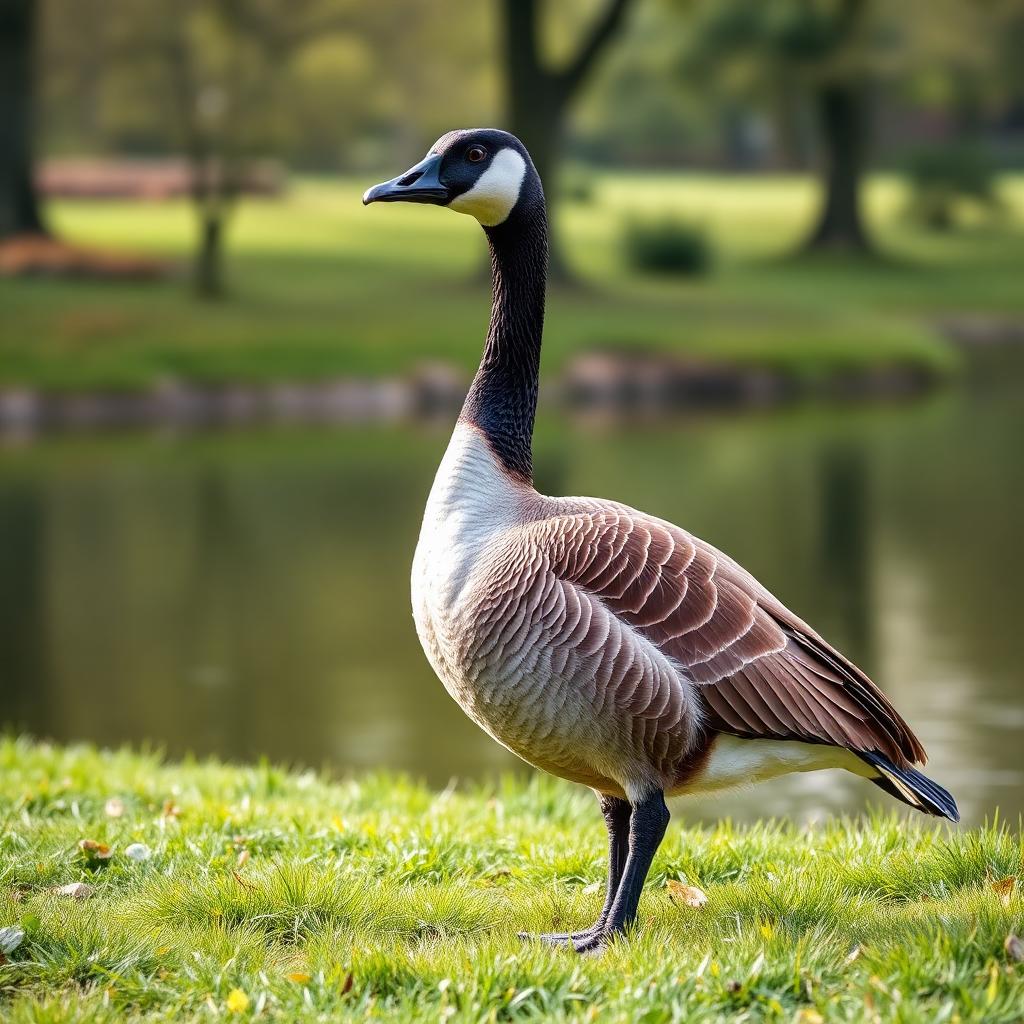
Canada Goose
Large grazing waterfowl that colonize corporate lawns, retention ponds, campuses, and airport buffer zones.
Identification
30–43 inches long with a 4–6 ft wingspan. Long black neck with white chinstrap, brown body, and pale chest. Loud honking flight call in V-formation flocks.
Diet
Grass, sedges, aquatic vegetation, waste grain, and turf on corporate campuses and golf courses.
Habitat
Turf adjacent to water — retention ponds, corporate campuses, golf courses, parks, airports, and industrial detention basins.
Nesting Habits
Ground nests on islands, pond edges, planter beds, rooftops, and elevated ledges near water.
Bowl of grass and vegetation lined with down feathers plucked from the female's breast.
4–7 creamy white eggs
25–30 days
42–50 days to fledge; young stay with parents for a full year
1 brood per year; will re-nest only if the first is lost early
Behavior
- Extremely site-loyal — return to the same nest site for life
- Both parents defend nest aggressively (hissing, wing-slaps, biting)
- Undergo a 4–6 week flightless molt in June–July when adults cannot fly
- Resident populations (non-migratory) now outnumber migratory geese in most metros
Canada Goose — Regional Nesting Activity
Select your region to see when this species courts, nests, and fledges young. Use it to time exclusion, inspection, and permitted mitigation work.
OH, IN, IL, MI, WI, MN, IA, MO, KS, NE, ND, SD
Damage & Health Risks
- Up to 3 lbs of droppings per goose per day on turf and walkways
- Aggressive attacks on employees during nesting (April–June)
- Water-quality degradation in retention ponds (E. coli, nutrient loading)
- Serious aviation strike hazard — a Canada goose flock brought down US Airways 1549
- Turf and landscape damage from overgrazing
Protected under the federal Migratory Bird Treaty Act. Egg addling, nest removal, and roundups require USFWS and state permits. Habitat modification, hazing, and exclusion are the legal front line.
Quick Facts
- USDA estimates 3.5+ million resident Canada geese in the U.S., up from ~230,000 in 1970.
- A pair of geese and their offspring can produce over 1,000 lbs of droppings per year.
- Adults are flightless during the summer molt — the only window for lawful roundup and relocation.
- Egg addling (permitted oiling) is the single most effective non-lethal population control.
Need a Commercial Bird Control Solution?
Tell us about your facility, bird problem, and project location. Our commercial bird control team can evaluate the situation and help determine an appropriate solution.