House Sparrow
Small, aggressive cavity-nester that colonizes signage, canopies, and structural voids.
Identification
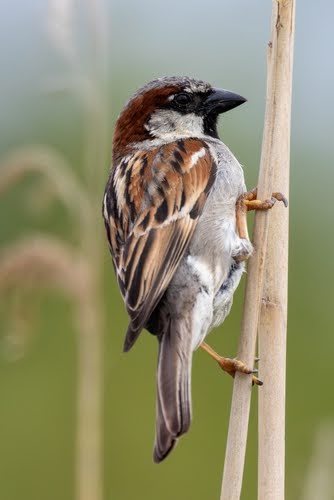
About 6 inches long. Males have a gray crown, black bib, chestnut back, and white cheeks. Females and juveniles are plain buff-brown with a pale eyebrow stripe.
Diet
Seeds, grains, insects, food scraps, and dropped crumbs around restaurants, big-box retail, and food-service loading areas.
Habitat
Almost exclusively human-associated — retail entryways, gas stations, warehouses, farms, grain facilities, and any structure with small openings.
Nesting Habits
Signage, HVAC equipment, exhaust vents, wall cavities, canopy corners, and any cavity 1.25 inches or larger.
Bulky mass of coarse grass, straw, paper, feathers, and trash — often fills the entire cavity.
4–5 eggs per clutch, pale with brown speckling
10–14 days
14–17 days to fledge
2–4 broods per year; commonly year-round in heated interior spaces
Behavior
- Highly territorial around nest sites; will evict native cavity nesters
- Live in colonies of 10–50 birds tied to a food source
- Squeeze through openings as small as 3/4 inch
- Nest debris is highly flammable — a serious fire risk in signage and lighting
House Sparrow — Regional Nesting Activity
Select your region to see when this species courts, nests, and fledges young. Use it to time exclusion, inspection, and permitted mitigation work.
OH, IN, IL, MI, WI, MN, IA, MO, KS, NE, ND, SD
Damage & Health Risks
- Nest material clogs gutters, drains, and exhaust vents
- Contaminates food product, packaging, and retail shelving with droppings
- Chews and shreds insulation
- Fire hazard in illuminated signage and electrical enclosures
Non-native invasive species. Not protected under the federal Migratory Bird Treaty Act. Control is legal nationwide.
Quick Facts
- Introduced to Brooklyn, NY in 1851 and now found across all 50 states.
- One of the most widely distributed wild birds on Earth.
- A single pair can produce 20+ young in one season.
- The USDA considers house sparrows an unprotected invasive species.
Need a Commercial Bird Control Solution?
Tell us about your facility, bird problem, and project location. Our commercial bird control team can evaluate the situation and help determine an appropriate solution.