Vultures
Large soaring scavengers that roost in flocks on communication towers, rooftops, and water tanks — federally protected.
Identification
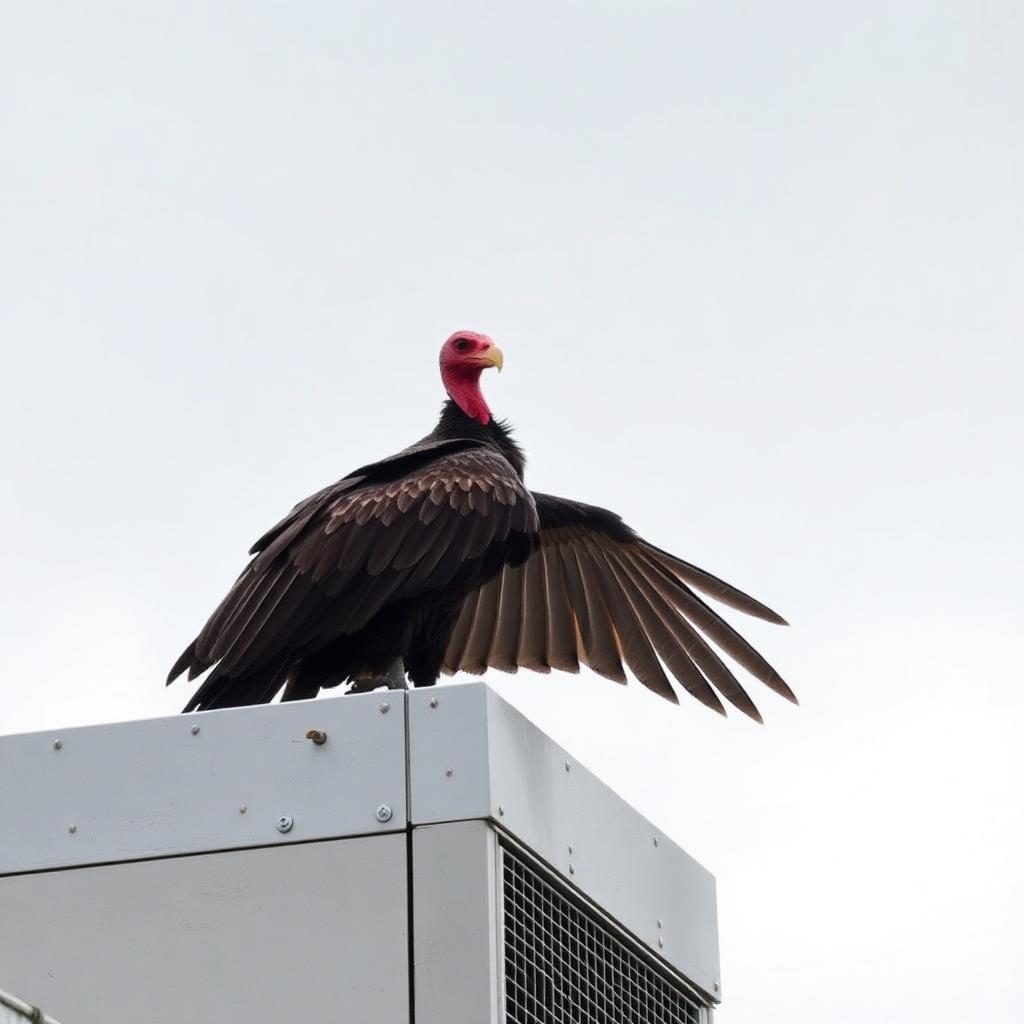
Turkey Vulture: 26–32 inches, 6-foot wingspan, dark brown body, featherless red head, silvery flight feathers, holds wings in a shallow V while soaring. Black Vulture: 23–27 inches, 5-foot wingspan, all-black body, featherless gray head, white wingtips, flaps more frequently with flat wings.
Diet
Carrion — road-killed and livestock carcasses. Black vultures also attack live newborn calves, lambs, and weak livestock, and scavenge landfills and dumpsters.
Habitat
Communication towers, transmission structures, water tanks, warehouse rooftops, grain elevators, cell towers, and mature trees near open country. Both species form communal roosts of 20–300+ birds.
Nesting Habits
Ground-level cavities — hollow logs, abandoned buildings, rock crevices, dense thickets, and undisturbed corners of vacant industrial structures. No nest is built; eggs are laid on bare substrate.
None — eggs deposited directly on the floor of the chosen cavity
1–3 eggs (typically 2), pale with dark blotches
37–41 days
70–88 days to fledge; parents feed young for 1–3 additional months
1 brood per year
Behavior
- Communal roosting — flocks of 20 to 300+ birds return to the same site nightly for years
- Turkey vultures locate carrion by smell (rare among birds); black vultures follow turkey vultures to food
- Black vultures actively prey on live newborn livestock — a growing problem in the Southeast
- Habitual perching on antennas, water tanks, and rooftop structures — droppings and regurgitated pellets accumulate below
Vultures — Regional Nesting Activity
Select your region to see when this species courts, nests, and fledges young. Use it to time exclusion, inspection, and permitted mitigation work.
OH, IN, IL, MI, WI, MN, IA, MO, KS, NE, ND, SD
Damage & Health Risks
- Damage to roofing membranes, caulking, rubber seals, and vehicle windshield wipers (both species chew and tear soft materials)
- Fouling of communication equipment, transmission insulators, and solar panels with droppings
- Livestock predation by black vultures — USDA estimates $9M+ in annual losses in the Southeast
- Aviation strike hazard around airports and industrial helipads
- Regurgitation as a defense — foul-smelling stomach contents ejected onto surfaces below the roost
Federally protected under the Migratory Bird Treaty Act. Lethal control requires a USFWS depredation permit. Non-lethal harassment (effigies, pyrotechnics, lasers) and exclusion (spikes, shock track, netting on protected roost surfaces) are the legal first line and are highly effective when applied consistently.
Quick Facts
- A hanging vulture effigy is the single most effective non-lethal roost-dispersal tool — USDA-endorsed.
- Black vulture populations have expanded northward more than 500 miles since 1970.
- Turkey vultures can smell carrion from over a mile away — one of the strongest senses of smell in any bird.
- Both species are entirely silent — they lack a syrinx and can only hiss and grunt.
Need a Commercial Bird Control Solution?
Tell us about your facility, bird problem, and project location. Our commercial bird control team can evaluate the situation and help determine an appropriate solution.